History of the Albert Street Church
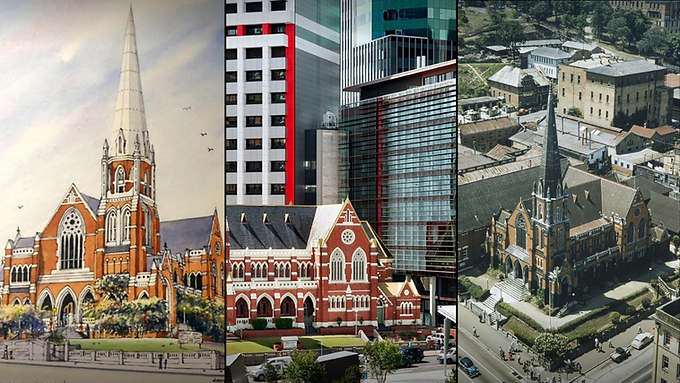
One of the most picturesque settings of the inner City is at the corner of Albert and Ann Streets, where two giant buildings dominate the skyline. Down at their feet, nestled in a garden setting on a slight rise is an architectural gem built in the Gothic style. Viewed from King George Square the Albert Street Uniting Church makes as pretty a picture as you would find on any postcard.
The five foundation stones were laid on August 18, 1888, and the completed church was opened by Lady Norman, wife of Sir Henry Norman, the Governor of the day, on November 8, 1889.
Historical Mapping and Overview

The first Methodist Church building in Brisbane was built from 1848-49 at a cost of £150 (almost $26,000 today). Many of the bricks and stone used in its construction had come from a demolished building on the corner of Queen and Edward Streets. It was opened on 10 March 1849, on the corner of Albert Street and Burnett Lane, where the Commonwealth Bank now stands. This was a plain rectangular brick building, 35 feet long by 18 feet wide, which could seat 150 people, and the congregation soon outgrew it.
A much larger church (image at left) was then built on the same site in 1856. It was built by Joshua Jeays, who also built Queensland’s Parliament House and the first stage of Old Government House. It cost £2667 (over $311,000 today), was 80 feet long by 40 feet wide, and could seat 500 people. This building had stained glass windows, some of which were transferred to the current church building. Several pews from the first building were kept, whilst additional pews were crafted for the second building. The first service in the second building was held on 6 December 1856.
This too, was outgrown, and land on the corner of Albert and Ann Streets was purchased in 1884 for £10,000 (approximately $1.75 million today) from the Masonic Lodge, and the present church constructed from 1888-89. The building was designed by George Henry Male Addison, who also designed the Old Museum Building in Bowen Hills, as well as many other buildings around Brisbane. The foundation stones were laid on 18 August 1888, and it was officially opened on Friday 8 November 1889 by Lady Alice Norman, wife of the Governor of Queensland, Sir Henry Norman. Other tradespeople involved in the building’s construction included Petrie & Son (joinery), and Exton and Gough (stained glass windows). The bricks for this new building were made from clay taken from the banks of a small creek, which ran through an area somewhere between where the Milton Railway Station now stands and Coronation Drive. The sandstone in the building came from Oamaru, New Zealand.
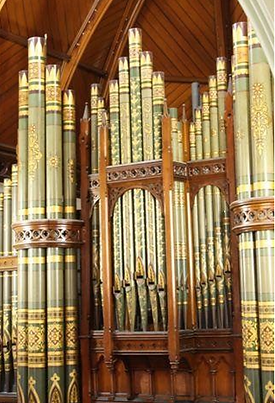
The organ was made in Manchester, England by George Benson, at a cost of £1,000 (around $175,000 today) and has 2,250 pipes. When the church was first opened, it was known as the Albert Street Wesleyan Methodist Church.
Seventy or so years later, the Methodist Church joined with the Congregational and some Presbyterian Churches to form “The Uniting Church in Australia” in 1977. This church has always been popular with its congregation. Many couples remember taking their wedding vows here, especially during the World War II years when as many as sixteen weddings took place each day.
In 2010 renovations were undertaken which included updating the bathroom and installing a disabled bathroom. In 2016 a major roof restoration was undertaken, costing 1.3 million.
Brief Summary of the Church Building Details and Interior
Cost:
The church was renovated in 1974/1975 at a cost of $128,476. A new roof and internal repairs were undertaken in 2016 at a cost of $1.3 million
Roof:
Welsh slate
Walls:
Brick, not buttressed
Timber:
Ceilings – Pine; Communion and Gallery Rails – Cedar
Pillars:
Solid steel, support gallery and roof
Windows:
Downstairs, mainly memorial. Upstairs, some memorial, the remainder original lead light. Nine windows on Ann Street side downstairs are a memorial to RAAF crew lost in World War II including the late Rev H M Wheller’s son, Douglas.
Organ:
Benson imported from Manchester England in 1889 for £1,000. Three manual organ. Some rebuilding in 1928 – chimes fitted. Major rebuild in 1951, cost $5,200. Complete rebuilding of organ in February 1985 at a cost of $77,000. Pipes: 2,250
Seating Capacity:
Church holds approximately 1,000 people. 350 downstairs and 650 upstairs.
Brief Summary of Superintendent Church Ministers and Mission
Mission Church: Since 1906 when Dr George Rowe, Minister introduced Sisters of the People, to assist poor, sick and needy in city and suburbs.
Ministers:
1888-1892 Rev Henry Youngman DD
1892-1895 Rev Arthur Webb
1895-1898 Rev Joseph Bowes
1899-1902 Rev C E James
1902-1906 Rev Joseph Snell
1906-1926 Rev Dr George Rowe, DD VD
1927-1952 Rev H M Wheller OBE
1952-1976 Rev George Nash OBE BA
1976-1994 Rev Ray Hunt OBE M M.Div
1994-2000 Rev Dr Bill Adams B.A, BD, Ph.D
2000-2005 Rev Dr David Pitman B.A, B.D, Ph.D, Dip.Ed
2006-2018 Rev Lyn Burden, B.Sc(Ed), B.Ed, B.Th, M.Ed, M.Th.
2018-2023 Rev Dr Peter Hobson Ph.D Th
2020-2024 Rev Melanie Wheeley B.Th, GradC Leadership
2024 – current Rev Brian Hoole
Historic Organ
The History of our Pipe Organ
The historical pipe organ was built in Manchester, England by George Benson and installed in the Church in 1889. Some additions were made to the original instrument in 1928. It underwent a rebuild in 1951 when it was enlarged and converted to electro-pneumatic action. The bellows were renewed in 1957 and the pedal board was remodelled in 1970 to what was accepted as standard.
In December 1982, a contract was awarded to J.W.Walker and Sons Pty Ltd for the restoration and rebuilding of the organ. This was carried out at a cost of $77,000 and was dedicated on February 24, 1985, in memory of Archie Day, who was Organist of this Church from 1933 until his death in 1975. The dedication was planned to coincide with the tenth anniversary of his death. The organ has 40 speaking stops distributed in the following manner: Great 13, Swell 11, Choir 9, Pedal 7. It is fitted with ten couplers, six thumb pistons on each manual and five toe pistons for the pedal department. The combination settings are adjustable from draw chest located at the console.
Majority of the original pipe work has been retained and with new additions there are now 2,250 pipes in this beautiful instrument. This organ is acknowledged to be one of the finest in Queensland and is one of the very few three manual pipe organs in this city.
Past Organists:
James Lord,
S G Benson,
A.H Littler,
Archie Day FTCL (42 years)
John Stephens FTCL (organist from 1975)
Present Organist:
Greg Hartay-Szabo since 2005.
More information on the organ is available at:
Uniting (formerly Methodist) Church Albert Street, Brisbane

Stained Glass Windows

The Eastern Transept
A set of four windows – Centre: two depict Jesus teaching
Side two show vine with grapes and lilies
Inscription In memoriam – E T Campbell
Designed and made by Philip John Handel

Set of four Windows – Centre two depicts Ruth and Naomi with words “Entreat me not to leave thee For whither thou goest. I will go”.
Side two show grapes and lilies.
Inscription – InMemoriam – M E Campbell
Designed and made by Philip John Handel
Eastern side Aisle:
“Enter into His Courts with Praise” Set of nine windows in groups of three. All of these windows are in memory of men and women killed during WWII depicting:

Set 1
Left to right:
Sir Launcelot: “A man of strength and will to right the wrong”.
Figure of Christ: “The Light of the World”.
Sir Tristram: “Fear God and Honour the King”. Dedicated to: In proud and affectionate memory of F/O Bruce Lionel Poole RAAF, KIA 27/1/1945.
Designed and made by Alfred Charles Handel

Set 2
Left to right:
Sir Bors: “Ever loyal man and true”.
Figure of Christ in the Garden of Gethsemane: “I am the Way”.
Sir Galahad: “If I loose myself, I save myself”.
Main Inscription: He sought the Glory of his country, He sees the Glory of his God”.
Dedicated to: In treasured memory of
F/O Douglas Wheller RAAF 29/3/44
Designed and made by Alfred Charles Handel

Set 3
Left to right:
King Arthur, Figure of the Risen Christ: “Come unto me”, St George.
To the Glory of God and in gratitude to the men and women who, under God saved our land from invasion 1939-1945.
Eric Ferguson, Alan Howson, Douglas
Wheller, Bruce Poole, Marcus Bensley, John Russell, James Allen, Neville Beacham, Leonard Phillips.
Designed and made by Alfred Charles Handel
Why are there Knights in the Windows?
In 1915 NSW Sunday School teacher, Alec Bray, invented the youth group Methodist Order of Knights (MOK). Its aim was to attract the older youth as involvement had declined significantly. Based on a combination of Christian ideals and Arthurian legends, the MOK quickly became popular among young boys aged 10 to 14. It was officially recognised as a Methodist youth organisation in 1929, complete with uniforms, regalia, secret handshakes and passwords. At the movement’s height in 1941 there were 1,018 societies of MOK throughout Australia, involving 41,772 members, along with an allied Methodist Girls’ Comradeship.
(Though with less Arthurian pomp). (G.W Potter – The Methodist Order of Knights and the Methodist Girls’ Comradeship: Formation of Orders: Growth, Decline and legacy in South Australia.)
Stained Glass Windows

The Western Transept
Set of four Windows
One central window depicts Christ with words “I am the true vine, Ye are the branches”.
Second central window shows fire burning diseased vine.
The two side windows show vine with grapes.
Inscription – He lived for others. In loving memory of W H Green OBE 18791968

Western Side Aisle
Set of three windows Left to right:
Figure of St Andrew.
Figure of Christ – “Follow me and I will make you fishers of men”.
Figure of St Peter.
Dedicated in memoriam of
John and Kate E Reid and their daughter Hilda M Hicks, lifelong members of this church. “The children rise up and call them blessed”
Designed and made by Alfred Charles Handel

Set of three windows depict:
“The Last Supper”
“Do this in Remembrance of Me,”
To the Glory of God and in memory of William Moore and the founders of this Church, the best of All is God is with Us. 1847-1947.
Designed and made by Alfred Charles Handel
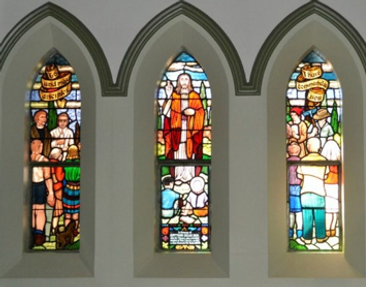
Set of three Windows:
Depict Christ preaching to a crowd of people in modern dress.
Inscriptions “Go and make disciples” and “I have commanded you”
In memory of Matthew Reid who for many years was a devoted member of this Church and served as Hon Treasurer for 36 years 1940-1976
Stained Glass Windows

The Gallery
Set of three windows depicting:
Left Panel:
Christ ascending, with watching Disciples “I ascend unto my Father”
Central panel shows Christ blessing the Disciples as He ascends.
Right panel shows other Disciples.
With inscription “and your Father” In abiding remembrance of our Parents’ lives of devoted service and example.
Rev William Henry Harrison 1860-1947 and Evangeline Harrison 1856-1926.
Called to higher Service, their works do follow them.
Designed and made by Alfred Charles Handel

Single Window: Baptism of Jesus Given in Loving Memory of William and Lily Bowering, by their family.

Single Window – The best of all is God is with us depicting an image of John Wesley.
In loving memory of Edith Lillian Capern 1904-1991 who was the mother of organist Brian Capern.

Eastern Transept Windows
Set of two windows believed to be from the Second Albert Street Church
Left panel: Prince of Wales feathers and leaf design
“Remember the Sabbath Day and keep it Holy”
Right panel: Prince of Wales feathers and flowers design “Enter into His gates with thanksgiving”

Western Transept Windows
Set of two windows believed to be from the second Albert Street Church
Left panel: “How amiable are Thy tabernacles O
Lord of Hosts”.
Right panel, text: “Bless ye the
Lord and magnify Him forever.”

Southern Gallery
This window was installed and dedicated in the church on the occasion of the Centenary Celebration in 1989. Depicting the church itself and the people, with Christ overlooking both and all Brisbane City.
Donated by the Laws Family.

Stained Glass above one of the doors.
Designed and made by Alfred Charles Handel
The Interior
Step into the beauty of the Heritage Listed Albert Street Church, even if you can't visit in person. Picture yourself walking down the stunning red carpet, surrounded by the warmth of varnished timber and the intricate artistry of each lead-light panel. Experience the awe and grandeur that this iconic space has to offer, inviting you to take part in its rich history and elegance.

Above: Stained Glass effect pouring into the church, from the back gallery side.

Above: Standing at the lectern viewing to the back of the Church and doors leading to the foyer.

Above: Ceiling woodwork design and feature.
Image taken from view of the gallery.

Above: Standing by the Organ and seats for the Choir to see almost into the gallery area.


Above from Left to Right:
The view down from the Gallery seating area.
View of the Altar.
Red carpet to welcome you in and out, from the foyer doors marked with the Uniting Church Emblem in stained glass.
The logo of the Uniting Church in Australia (UCA) shows the cross of Jesus Christ, in its light and love, standing over a darkened world — redeeming it through grace and truth.
By that cross people are bound to Christ and each other. The Holy Spirit, symbolised by the dove with the wings of flame, empowers and guides us to be witnesses to Jesus Christ.
The wide U at the bottom points to the fact that we are uniting; as a semicircle it also reminds us that the renewing of both church and world are as yet incomplete.
The logo symbolises something of the vision we have glimpsed and the hopes we hold for the future. In particular it reminds us:
-
that the gospel message is central in all that we seek to do;
-
of the need for constant reform and renewal;
-
of our commitment to worship, witness and service.
Memorial Plaque for World War 1
The names listed in black are those that did not return. The names are listed alphabetically, with no indication of rank, and include the names of the nurses who went to war as well.
Navigate to our History webpage for more information on the Honour Roll and those who served during WWI.

